
Who actually decides how your payments work?


The answer is often a little awkward. On paper, it's obviously the CFO, the head of product or whoever runs e-commerce. But in practice, many end up having to call for help every time something needs changing. They call support, the developer who built the integration three years ago, or the vendor of the risk module that was added on top.
It's not that gateways lack features. It's more that the features are rarely in one place. Some of the logic sits in the dashboard, some sits in the integration code, where you need someone who knows what they're doing, and the advanced rules usually sit behind an extra licence that has to be ordered first.
So suddenly it becomes a three-week job to remove a payment method on large orders or to turn up 3D Secure in certain situations. Something that should take three minutes.
You'd think the people who understand the business would also have their hands on the wheel. Unfortunately, that's not always the case. That's the whole reason we've built our rule engine into ePay Backoffice.
Rules without the detours
This is where you start making the decisions yourselves. And it's no more complicated than this: if the amount is over X, require 3D Secure. If the card was issued in Nigeria, decline it. A US corporate card? Route it to the acquirer that handles them most cheaply.
You set up the rules visually in ePay Backoffice. No code, no deployments and, most importantly, no depending on someone else having the time.
It sounds easy, and it is. It's how it should have been all along.
What's interesting isn't just what it can do, but who can use it. Product, marketing and finance can adjust the payment logic themselves without having to book a developer. Decisions are made where the business knowledge is, and changes can be rolled out the same day.
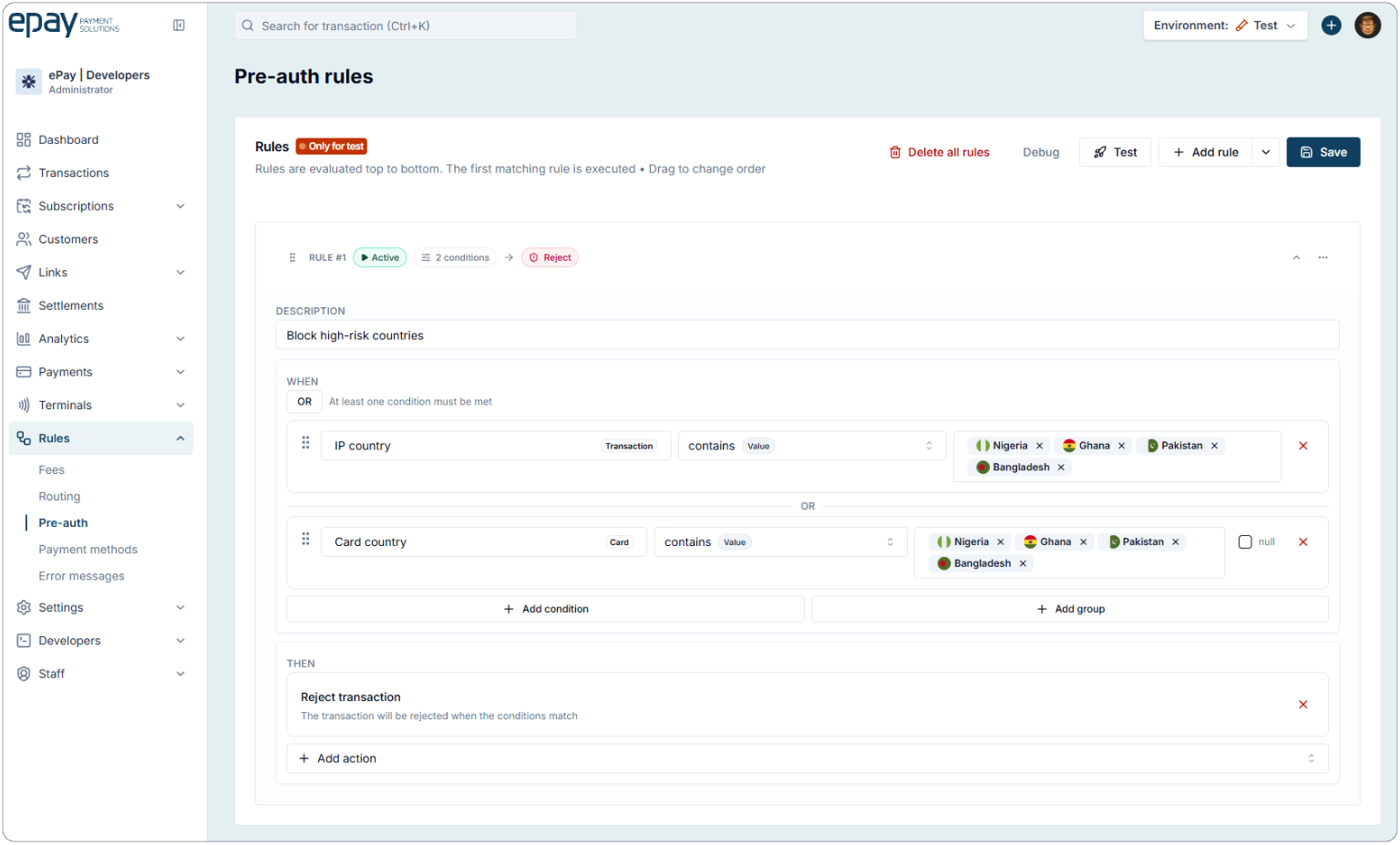
Pre-auth rule that declines payments if the IP address or card comes from a high-risk country.
Four things you can use it for today
Routing. Not all acquirers are equally good at the same things. Some have higher approval rates on certain card types. Others are cheaper in certain markets. With rule-based routing, you send the transaction to the acquirer that makes the most sense, based on currency, card type, payment method and other parameters.
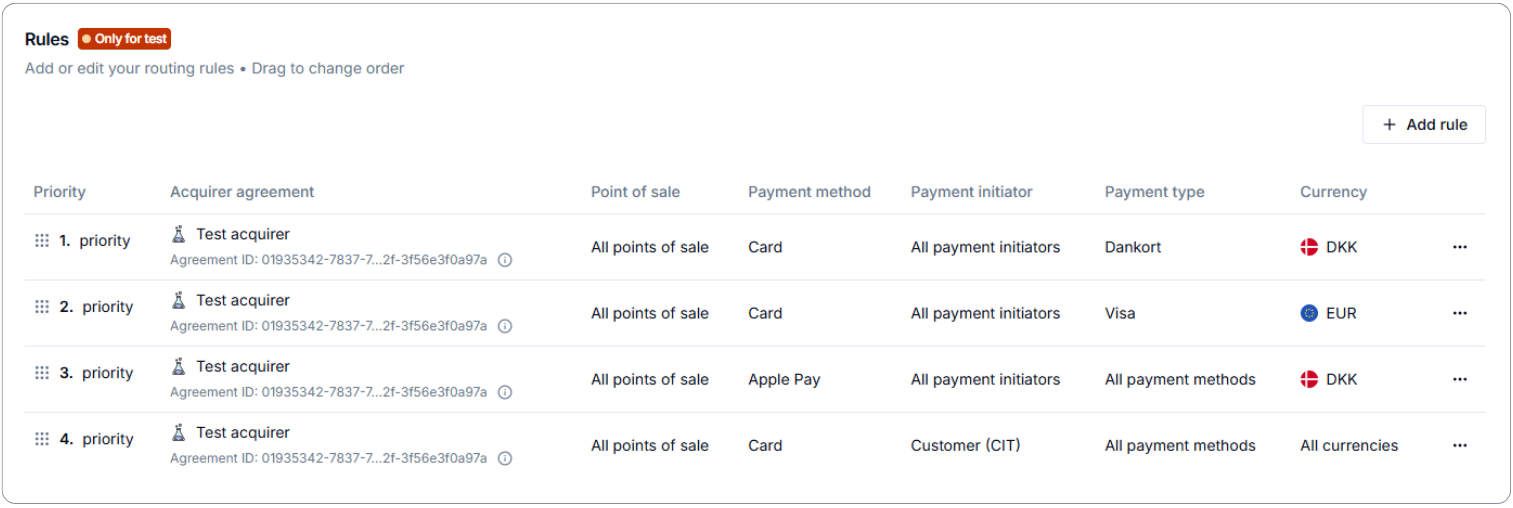
Set up routing rules and control the priority yourself.
Managing payment methods. On a DKK 450 order, a mobile wallet like Vipps is a pleasure. On a DKK 18,000 order, it’s a fee nightmare. You can remove specific payment methods when certain conditions are met, so customers only see what makes sense to offer.
Pre-auth rules. This is where you decide who gets through at all. Cards from countries you don't sell to can be declined straight away. Bots can be stopped before they pollute your data. And small, low-risk payments can skip 3D Secure, so the customer doesn't drop off along the way.
Surcharges. An international corporate card can easily cost 3 to 4 times as much to accept as a Danish corporate card. You can start simply by setting percentage rates per card type and region. And when you're ready, you can add advanced rules on top that say, for example, "no surcharge on subscriptions" or "only surcharge corporate cards issued outside the EEA".
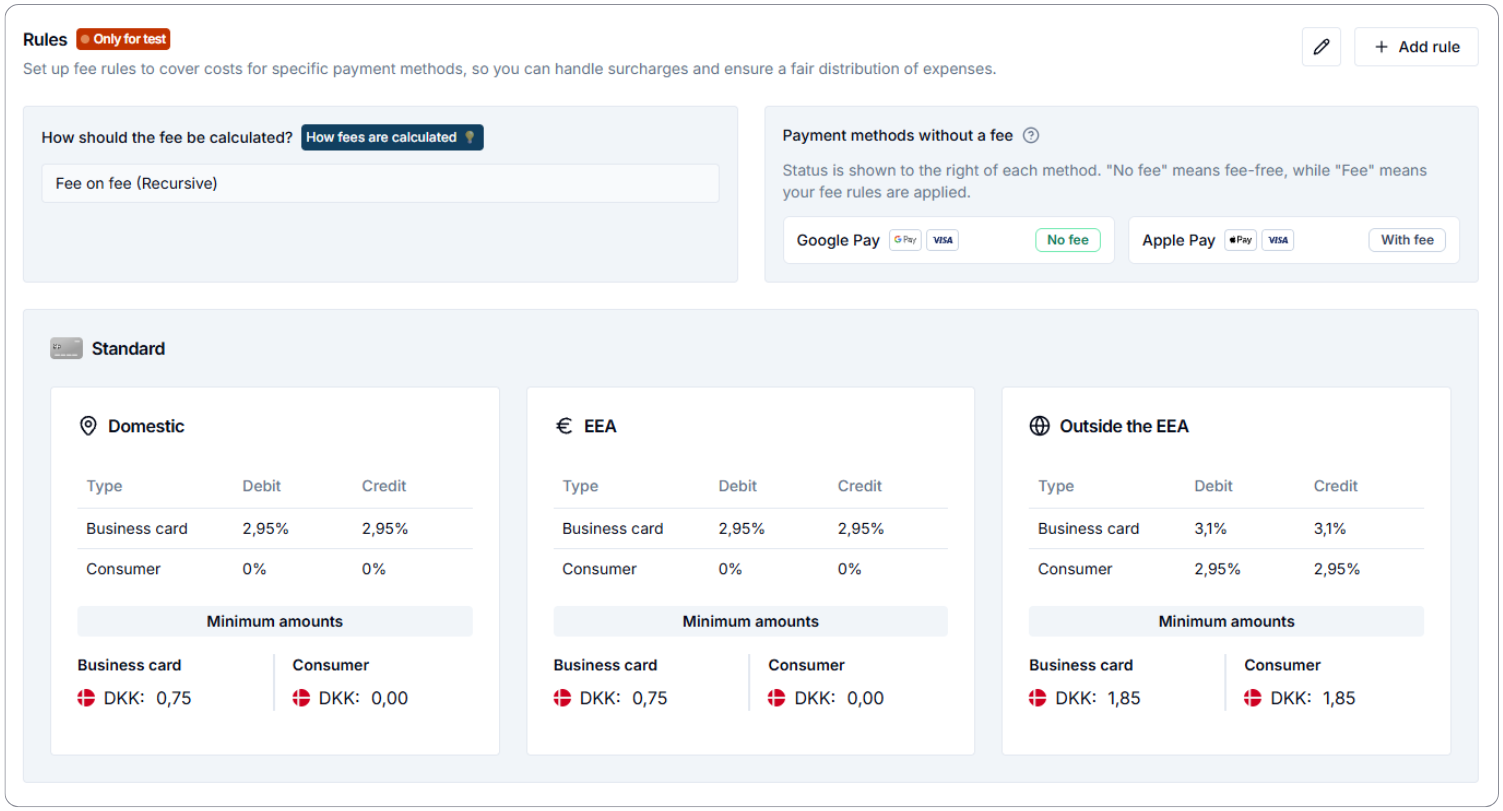
Set up surcharge rules to cover the cost of specific payment methods.
Templates for anyone who'd rather not start from scratch
You don't have to sit and build the rules from the ground up. There are ready-made templates for the use cases we see again and again, including:
- Enforce 3D Secure for large amounts
- Block high-risk countries
- Block cards issued outside the EEA
- Block known bots and automated traffic
- Skip 3D Secure for small amounts (LVT exemption)
- Repeat payments without 3D Secure (TRA and LVT exemptions for known customers)
- Stricter security for large amounts without stored card details
Use them as they are, or adapt them to your business. The point is the same: you decide how your payments behave.
It doesn't take three weeks
It's not that payments have become simple. They're still complex. They've just become something you can work with, without having to call someone first.
If you want to see what the rule engine looks like from the inside, you can create a free test account and take a look yourself. Or get in touch if you'd rather have the short version.


